


Disclosure: IRA Wealth Guide may earn compensation from some links or partner placements. That never changes our evaluation criteria or recommendations.
Not financial advice: This page is informational. Consult a qualified tax professional or financial advisor for guidance specific to your situation.
Written by Mike Reeves
Mike Reeves is a precious metals IRA specialist with over 10 years of industry experience, having evaluated dozens of providers across the United States. He has helped hundreds of investors roll over traditional retirement accounts into precious metals IRAs, with a focus on fee transparency, compliant storage, and investor-first guidance.
Last updated: January 2026
Start Here: The fastest way people lose money in a Gold IRA
The biggest risk in a Gold IRA is rarely gold itself. It’s getting sold an overpriced product under pressure—usually inside a self-directed IRA (SDIRA) rollover where the buyer thinks they’re protected.
Regulators have repeatedly warned that precious-metals fraud and abusive pricing often target retirees and near-retirees, especially those rolling funds from employer plans into “gold IRAs.”
This guide shows you:
- the exact scam patterns regulators highlight,
- the pricing traps that make profits difficult,
- the questions and scripts that force clarity, and
- a step-by-step buyer checklist to protect your rollover.
Key Takeaways
- “Gold IRA company” usually means the dealer, not the custodian; your IRA is legally held by a custodian and metals must be held under qualified custody.
- Regulators warn that fraudsters use fear, urgency, and misleading claims to push rollovers into SDIRAs where investors may be “on their own.”
- The most common money-losing traps are excessive spreads/markups, “free silver” promos that mask higher pricing, and pushing high-premium collectible-style coins.
- The CFTC’s “Lies vs Facts” warns spreads can be 30% to 300% or more, which can make breaking even extremely difficult.
- If you suspect wrongdoing, you can report issues via the SEC and CFTC portals and contact your state securities regulator (NASAA directory).
Compare quotes safely: use our Gold IRA Quote Checklist.
Why Gold IRA scams are so common (and why rollovers are the target)
1) The money is concentrated in retirement accounts
Fraudulent dealers focus on rollovers because that’s where most people hold their largest balances. The CFTC’s scam-awareness materials explicitly describe rollovers as a primary target.
2) SDIRAs create a “false sense of safety”
The SEC warns that self-directed IRAs can expose investors to fraudulent schemes, high fees, and risky assets, and that custodians typically do not evaluate the quality or legitimacy of investments.
3) Pricing opacity makes abuse easy
Many precious-metals dealers do not publish live pricing and can “manage” the conversation toward products with the largest margins. This is why regulators emphasize questions about total costs, markups, and fees.
The “Gold IRA scam” reality: it’s usually not fake gold—it’s abusive pricing + manipulation
Most victims don’t receive counterfeit metal. They receive real metal at an unfair price, often paired with:
- excessive dealer markups,
- misleading claims about legality, safety, or “special” coins,
- pressure tactics that prevent comparison shopping.
The SEC’s action against Red Rock Secured alleged markups as high as 130% and stated the firm used fear to drive sales.
Separately, the CFTC’s “Lies vs Facts” warns spreads can range from 30% to 300% or more.
Investor-first translation: You can lose years of returns on day one if you overpay.
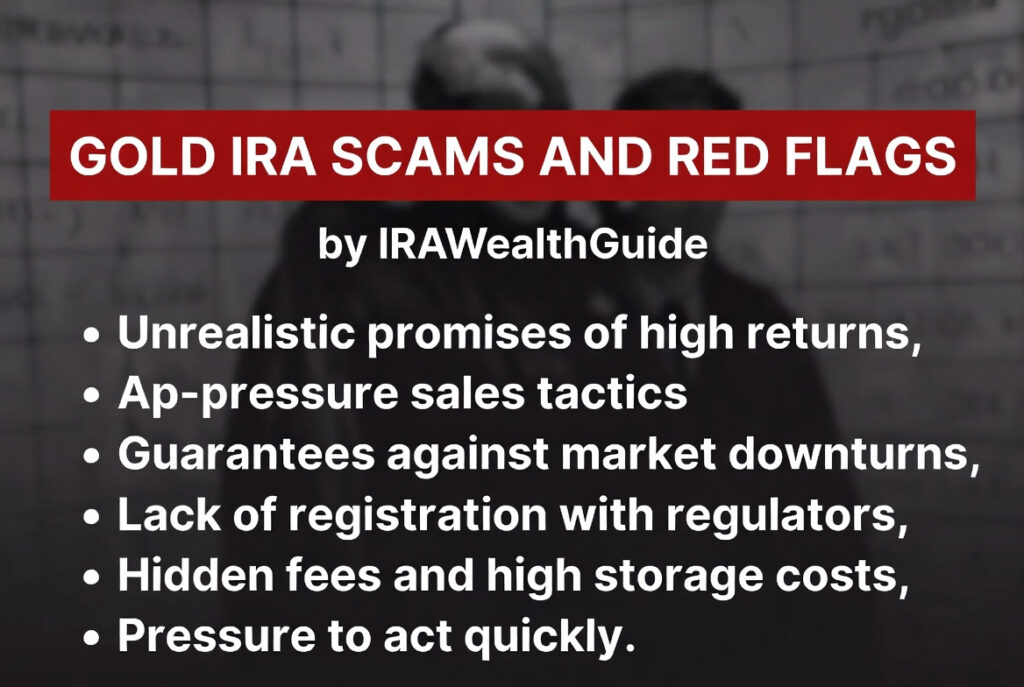
The 12 biggest Gold IRA scam red flags (ranked by severity)
Red Flag #1: They won’t answer one simple question—“What’s my premium over spot?”
If a company won’t provide an itemized quote showing:
- the exact product,
- the per-unit price,
- and the premium above spot,
you don’t have pricing transparency. The CFTC/FINRA bulletin stresses asking direct questions about pricing, fees, and the dealer’s practices before rolling retirement funds.
What to do: Require a written, itemized quote on the exact coins/bars.
Red Flag #2: Fear-first scripts that push you into immediate action
The SEC alleged fear-based tactics in a major precious-metals enforcement case.
CFTC/FINRA materials also warn that fraudsters commonly use emotional manipulation to rush retirees.
What to do: Any pitch built on panic is a signal to slow down and compare.
Red Flag #3: “Free silver” / “bonus metals” / “limited-time promo” that avoids real pricing
Promotions are not automatically scams—but they are frequently financed by higher spreads. The CFTC warns that excessive spreads and fees can make it hard to profit, and its scam flier is explicit that the spread can be extremely large.
What to do: Ask: “Show me the all-in price per ounce and the premium over spot for each item.”
Red Flag #4: Defaulting to high-premium “collectible” or “rare” coins in an IRA
A common abusive tactic is steering IRA buyers into high-premium coins under the guise of “extra safety” or “government protection.” Regulators warn about misleading claims and advise investors to ask questions before rolling funds into a metals IRA.
Rule of thumb: In most retirement portfolios, you want liquidity + fair pricing, not “collector narratives.”
Red Flag #5: “Home storage Gold IRA” claims presented as easy and universally legal
Be cautious with any pitch that frames home storage as a simple loophole. The IRS bullion exception is tied to qualified custody (physical possession by a bank or approved trustee/custodian), and regulators warn SDIRAs are fertile ground for fraud and misinformation.
What to do: Verify storage compliance with your custodian and your tax professional before acting.
Red Flag #6: They blur the roles of dealer vs custodian vs depository
The SEC warns that SDIRA custodians often don’t evaluate investment quality, and investors may mistakenly assume the IRA structure itself “vets” the deal.
What to do: Make them name all three entities:
- Dealer (sells metals)
- Custodian (administers IRA)
- Depository (stores metals)
If they can’t explain this cleanly, do not proceed.
Red Flag #7: “We’re recommended by” / fake endorsements / affinity marketing
Regulators and consumer education pieces have highlighted affinity-style marketing (targeting retirees in groups with shared identities or interests) and the misuse of credibility signals. The safest approach is to treat endorsements as non-evidence and insist on pricing, documentation, and written terms.
Red Flag #8: They won’t put buyback terms in writing
The CFTC/FINRA questions emphasize understanding how you can sell and at what cost.
What to do: Ask for buyback policy language and how repurchase pricing is determined.
Red Flag #9: “You don’t need to talk to your CPA/plan administrator”
A dealer who discourages independent advice is minimizing friction—because friction prevents bad deals.
Red Flag #10: The paperwork is rushed or “handled entirely” without your review
A rollover mistake can create withholding/tax issues. A reputable process is transparent and slow enough for you to understand.
Red Flag #11: They won’t provide total first-year cost summary
You should receive a written summary of:
- custodian setup fee,
- annual custodian/admin fee,
- storage + insurance fee,
- transaction/wire fees (if any),
- plus dealer pricing.
Red Flag #12: They avoid direct questions with “don’t worry, everyone does this”
That’s not a compliance or pricing answer.
The “Scam Playbook” vs “Reality” (table you can publish)
| Sales claim | Reality check | What to ask |
|---|---|---|
| “Gold is always safe—put most of your retirement into it.” | Regulators warn excessive spreads/fees can make profit difficult; concentration risk is real. | “What’s the spread/premium and total first-year costs?” |
| “This special coin is protected / can’t be seized / is safer.” | “Special status” claims are common marketing hooks; demand documentation. | “Why this product vs a lower-premium bullion alternative?” |
| “Free silver—today only.” | “Free” is often funded through higher pricing; CFTC warns spreads can be very high. | “Show the premium over spot per item.” |
| “Move fast or you’ll lose everything.” | Fear-based urgency is a classic manipulation signal; SEC alleged fear tactics in a major case. | “Email me the full quote; I’ll compare it.” |
| “Don’t worry about the details—our IRA team handles everything.” | SDIRA custodians may not evaluate investment quality; you must do diligence. | “Who is the custodian and depository? What are their fees?” |
The pricing trap that matters most: spreads, markups, and “instant losses”
The CFTC’s warning on spreads is blunt
The CFTC’s “Lies vs Facts” notes that when you buy, dealers charge more than spot; when you sell, they pay less—creating a spread that it says can range from 30% to 300% or more.
Why spreads are devastating inside retirement accounts
Retirement investing relies on compounding. If you overpay:
- you start with a loss,
- you need larger price increases just to break even,
- and you may not realize the damage until liquidation.
Real enforcement example: alleged triple-digit markups
In its press release, the SEC alleged Red Rock Secured charged markups as high as 130%.
Practical investor rule: If a dealer can’t tell you the premium over spot, assume you’re paying too much until proven otherwise.
See the full Gold IRA fee stack (custodian + storage + spreads).
The regulator-backed question set: “10 Things to Ask” before buying metals for an IRA
The CFTC and FINRA jointly published “10 Things to Ask Before Buying Physical Gold, Silver, or Other Metals,” explicitly noting precious-metals IRA frauds often target retirees and urging investors to ask specific due-diligence questions before rolling retirement assets.
Here is a buyer-adapted version that aligns with their guidance:
Dealer legitimacy and conduct
- “Are you registered or licensed where required, and who supervises your sales practices?”
- “Do you have complaints, enforcement actions, or unresolved disputes?” (Verify independently.)
Pricing and fees (the deal-killers)
- “What is my total all-in cost today, itemized per product?”
- “What is the premium over spot for each item?”
- “What fees will I pay besides the metal price (shipping, insurance, handling, custodian, storage)?”
IRA mechanics and custody
- “Who is the IRA custodian, and what is the custodian’s full fee schedule?”
- “Which depository will store the metals, and what are storage/insurance costs?”
- “Is storage segregated or non-segregated, and what does that change?”
Exit plan
- “What is your buyback policy and how is repurchase price calculated?”
- “If I liquidate, what is the expected process timeline and any transaction fees?”
The exact scripts to use on calls (copy/paste)
Script A: The quote discipline script (forces transparency)
“Please email me a written quote with the exact items, per-item pricing, and the premium over spot. Include all custodian and storage fees for year one. I’m comparing two providers on the same items.”
Script B: The collectible push stopper
“I’m not buying anything primarily for ‘rarity’ or ‘collectibility’ inside a retirement account. If you recommend anything other than standard IRA-eligible bullion, explain why, and show the premium versus a lower-premium alternative.”
Script C: The urgency disarm
“I don’t make retirement decisions on a deadline. If the offer expires today, that’s fine. Email the quote.”
Due diligence checklist (printable)
Use this checklist before any rollover funding:
Pricing proof
- Written, itemized quote (product + per-item price + total)
- Premium over spot disclosed for each item
- No “mystery promos” (bonuses reflected in transparent pricing)
IRA structure proof
- Custodian named + fee schedule provided
- Depository named + storage fees provided
- Storage type explained (segregated vs non-segregated)
Exit proof
- Buyback terms in writing
- Liquidation process explained (timing + fees)
Behavior proof
- No fear-first pitch
- No pressure to avoid independent advice
- No refusal to send details in writing
The most common Gold IRA scams and how to beat each one
1) The “overpriced bullion” scam (most common)
What it looks like: Real gold/silver, wildly inflated pricing.
Regulator context: CFTC materials emphasize excessive spreads and fees can prevent profit, with spread ranges stated as extremely wide.
Your defense: Insist on per-item premium over spot and compare at least one competitor quote on identical items.
2) “Collectibles in an IRA” confusion
What it looks like: The pitch is framed as protection or exclusivity; pricing is high.
Your defense: Ask whether the product is chosen for metal value/liquidity or for a collectible narrative. If it’s the latter, walk.
3) The “free metals” illusion
What it looks like: “Up to $X in free silver” tied to rollovers.
Your defense: Convert the entire deal into math:
- total dollars sent
- total ounces received
- implied all-in price per ounce
If the implied price is above market norms, the “free” metal is funded by your overpayment.
4) The “fake urgency” rollover trap
What it looks like: “Markets will crash tomorrow, move today.”
Regulator context: SEC alleged fear-based sales tactics in a prominent case.
Your defense: Email-only policy for quotes; no same-day funding.
5) The “SDIRA credibility laundering” trick
What it looks like: “Because it’s in an IRA, it’s safe/approved.”
Regulator context: SEC warns SDIRAs can be used to lend credibility to fraudulent schemes and that investors bear the responsibility for diligence.
Your defense: Treat the IRA as a container, not a vetting process.
If you already bought and suspect you were scammed: what to do next
This is not legal advice—just a practical action sequence.
Step 1: Gather documentation (same day)
- invoices and trade confirmations
- any “spot price” references and timestamps
- emails/texts and recorded call notes
- custodian statements showing purchase amounts
- product lists and quantities received in storage
Step 2: Request a written breakdown from the dealer
Ask for:
- spot price at time of trade
- premium per item
- total spread explanation
- buyback quote on the same items (test pricing discipline)
Step 3: Escalate to the custodian (if applicable)
Ask whether the custodian has recorded complaints and whether the dealer is on any restricted list.
Step 4: Report concerns to regulators (official channels)
- SEC: Submit a tip/complaint using the SEC portal.
- CFTC: Submit a tip/complaint through the CFTC complaint page.
- State securities regulator: Use NASAA’s “Contact Your Regulator” directory.
If your issue involves a broker-dealer or registered rep, FINRA also provides a complaint process.
Step 5: Speak with independent counsel / tax professional
Especially if you suspect a rollover error, prohibited transaction, or tax reporting issue.
FAQs: Gold IRA Scams and Red Flags (People Also Ask)
Most losses come from overpriced metals sold with high spreads/markups, often paired with pressure tactics. The CFTC’s “Lies vs Facts” warns spreads can range from 30% to 300% or more, making profit difficult.
If the dealer won’t disclose the premium over spot per item, or refuses to provide an itemized quote, you cannot verify pricing integrity. Regulators advise investors to ask detailed questions about costs and pricing before rolling retirement money into metals.
Not always. Many are metals dealers, not fiduciary advisors. The SEC warns SDIRAs can expose investors to fraud and that custodians generally don’t evaluate investment quality.
The CFTC and FINRA issued an investor bulletin warning about precious metals frauds, especially involving SDIRAs, and published “10 Things to Ask” before buying physical metals.
Bottom Line: Your anti-scam strategy in one paragraph
Do not buy a Gold IRA on a phone script. Buy it like a professional purchaser: demand a written, itemized quote, insist on premium-over-spot disclosure, confirm custodian + depository + storage fees in writing, and compare at least one competitor using the same IRA-eligible items. Regulators warn precious-metals IRA frauds often rely on fear, urgency, and pricing opacity—your job is to remove all three.
Review compliant providers: Top Gold IRA Providers of 2026.