


Start Here: The 30-Second Decision Summary
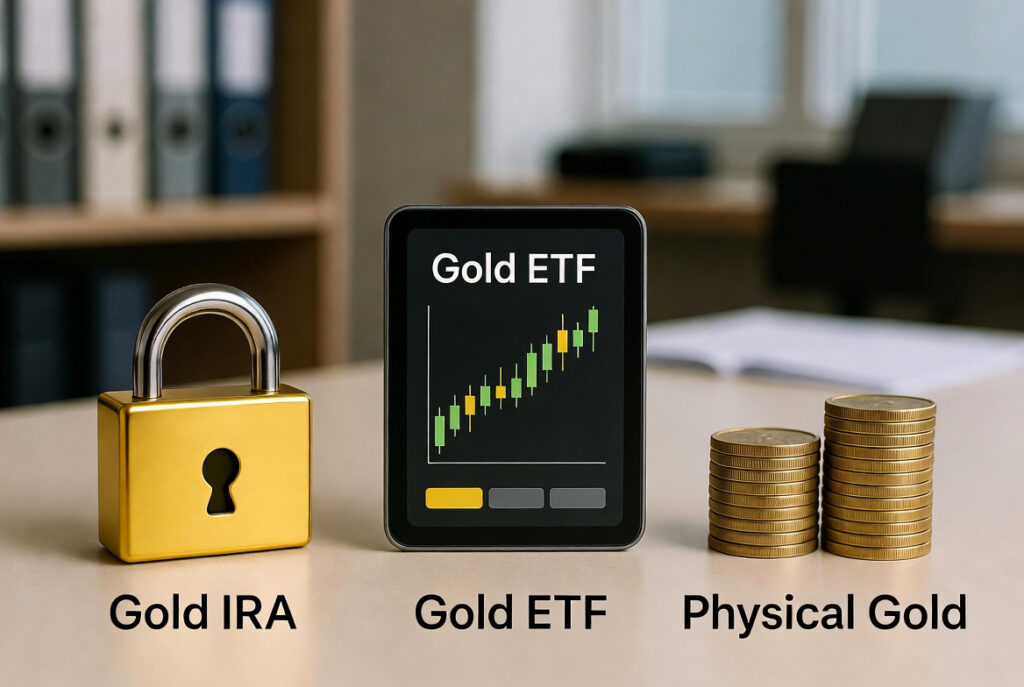
If your top priority is tax-advantaged retirement ownership of physical bullion with compliant storage and long-term allocation discipline, a Gold IRA can make sense—especially for mid-to-large rollovers where you want metals held inside an IRA wrapper. If your priority is simplicity, instant liquidity, and low friction (and you’re comfortable with “paper gold” exposure), a gold ETF (like GLD) is often the cleanest solution. If your priority is direct control and privacy of physical metal (and you can manage storage and insurance yourself), buying physical gold outside an IRA can be the best fit.
This page helps you choose based on ownership, costs, taxes, liquidity, and risk—not marketing.
Not financial advice: This page is educational. Consult a qualified tax professional or financial advisor for guidance specific to your situation.
Written by Mike Reeves
Mike Reeves is a Gold IRA specialist with over 10 years of industry experience, having evaluated dozens of providers across the United States. He has helped hundreds of investors roll over traditional retirement accounts into precious metals IRAs, with a focus on fee transparency, compliant storage, and investor-first guidance.
Last updated: January 2026
Why This Comparison Matters (And Why So Many Investors Pick the Wrong “Gold”)
Most investors don’t fail because they chose gold. They fail because they mixed goals:
- They wanted a hedge but bought like a speculator
- They wanted insurance but bought like a collector
- They wanted liquidity but used the least liquid structure
- They wanted “physical gold” but didn’t understand custody vs ownership
A smart gold decision starts with one question:
What job do you want gold to do in your retirement plan?
- Stabilizer/hedge against inflation and equity volatility
- Crisis insurance (tail risk protection)
- Tactical trade or speculation on gold price
- Long-term store of value alongside stocks and bonds
Each “gold vehicle” is optimized for different jobs.
Gold IRA vs Gold ETF vs Physical Gold: The Investor-First Comparison Table
| Feature | Gold IRA (Physical Bullion in IRA) | Gold ETF (e.g., GLD) | Physical Gold (Outside IRA) |
|---|---|---|---|
| What you own | Specific IRA-eligible bullion held under qualified custody | Shares of an ETF (paper claim designed to track gold) | Coins/bars you personally possess |
| Storage | Required at an approved depository via custodian (not home) | No storage for you (fund handles custody) | You manage storage (safe, vault, insurance) |
| Liquidity | Moderate (custodian process + dealer bid) | Very high (intraday trading) | Moderate (sell to dealer/private market) |
| Typical ongoing costs | Custodian + storage fees (often hundreds/yr) + dealer spread | ETF expense ratio (GLD is commonly listed at 0.40%) | Storage/insurance costs vary (can be $0–$1,000+/yr depending on approach) |
| Biggest “hidden” cost | Dealer premium/spread on coins/bars | Tracking + expense drag over time | Buying/selling spreads; security/insurance |
| Taxes (taxable account) | N/A (inside IRA) | Many physically backed gold ETFs are taxed like collectibles; GLD’s own tax materials discuss max 28% long-term collectibles rate | Physical gold gains can be taxed as collectibles (up to 28% LT cap, depending on circumstances) |
| Taxes (retirement account) | IRA rules apply on distributions (Traditional vs Roth) | Same as any ETF inside IRA (distributions follow IRA rules) | Not an IRA asset unless held via IRA structure |
| Counterparty / structure risk | Operational reliance on custodian + depository + dealer | Fund structure/custodian reliance; market plumbing | Minimal counterparty; higher personal responsibility |
| Best for | Long-term retirement allocation to physical bullion | Simplicity, liquidity, tactical allocation | Direct control, privacy, non-retirement allocation |
Important compliance note: The IRS states bullion can be held in an IRA if a bank or approved non-bank trustee maintains physical possession.
Start Here: What Each Option Really Is (Plain English)
1) Gold IRA (Physical Gold Inside a Self-Directed IRA)
A Gold IRA is typically a self-directed IRA that holds IRS-eligible gold bullion/coins, administered by a custodian, and stored at an approved depository under qualified custody. The core advantage is retirement-account tax treatment while holding physical metal—so long as you follow the custody rules.
2) Gold ETF (Like GLD)
A gold ETF is a tradeable security designed to track gold prices. You do not take delivery of coins or bars; you own shares. The main advantage is liquidity and simplicity—you can typically buy/sell instantly during market hours, hold it in most brokerage accounts, and avoid storage logistics. Expense ratios apply (GLD is commonly listed at 0.40%).
3) Physical Gold Outside an IRA
This is the most literal form: you buy coins/bars and you control storage. The advantage is direct possession and independence from financial intermediaries. The tradeoff is that you must solve storage, insurance, and resale logistics yourself.
When a Gold IRA Makes Sense (And When It Doesn’t)
A Gold IRA makes sense when…
You’re prioritizing retirement structure + physical ownership. A Gold IRA is most rational when the “job” you want is:
- Long-term diversification inside retirement accounts
If you’re building a portfolio where gold is a strategic allocation (not a trade), an IRA wrapper can be compelling. - You’re rolling over a meaningful balance
Gold IRAs are fee-heavy relative to small allocations. The fixed annual cost can be manageable when the allocation is meaningful—but punishing on small balances. - You want compliant bullion custody (and you’re fine not touching it)
If you want physical bullion but accept that IRA metals are stored under qualified custody (not at home), you fit the correct compliance posture. - You want a disciplined buying process
If you’re willing to demand itemized quotes, avoid high-premium traps, and use a low-pressure workflow, a Gold IRA can be executed “cleanly.”
Recommended next steps if you choose a Gold IRA:
A Gold IRA usually does not make sense when…
- Your allocation is small and fee drag will dominate
If you’re allocating a modest amount, the annual custodian/storage fees can consume the diversification benefit. - You want instant liquidity or frequent trading
Gold IRAs are not trading accounts. Selling often requires custodian paperwork and dealer bids. - You are tempted by “home storage IRA” narratives
The IRS’ framing emphasizes qualified physical possession by a bank or approved non-bank trustee for bullion eligibility—home storage pitches are a risk magnet in this niche. - You’re not willing to price-compare
If you won’t compare itemized quotes, the dealer spread/premium can quietly become your biggest cost.
If any of these are true, a gold ETF or physical gold outside an IRA may be a cleaner fit.
When Gold ETFs Make Sense (Simplicity, Liquidity, and Control)
ETFs make sense when…
- You want “set-and-forget” exposure
You can allocate to gold in a brokerage account or IRA with minimal friction. - Liquidity is a top priority
ETFs trade intraday. That matters if you want the option to rebalance quickly or reduce gold exposure on short notice. - You want predictable and visible costs
ETF expense ratios are disclosed. For example, GLD is widely listed at 0.40%. - You want to avoid depository logistics
No storage selection, no custodian paperwork for metals, no shipping.
ETFs are not ideal when…
- You want physical possession or the psychological benefit of “real metal”
- You have concerns about intermediary structures
- You want to avoid the collectibles-style tax treatment in taxable accounts (some physically backed products have special tax considerations; GLD’s tax materials discuss collectibles treatment)
Practical nuance: If you hold a gold ETF inside an IRA, the IRA distribution rules generally govern tax timing, but you still want to understand the product structure you own.
When Physical Gold Outside an IRA Makes Sense (Direct Control)
Physical gold outside an IRA makes sense when…
- Your goal is personal control and autonomy
You own it. You store it. You decide when to sell. - You want “insurance-style” ownership
Some people want a portion of wealth outside brokerage systems for peace of mind. - You want flexibility without IRA rules
You can buy/sell without custodian forms and without IRA distribution rules.
Physical gold outside an IRA is not ideal when…
- You are not prepared to handle secure storage and insurance
- You are buying based on fear rather than a plan
- You are tempted into high-premium “story coins” without understanding resale realities
Cost Breakdown Scenarios: Small vs Large Allocation (What Most Pages Get Wrong)
Most comparisons talk about costs in isolation. The right way is scenario-based: fixed fees hurt small balances; spreads hurt everyone.
Scenario 1: Small allocation (fees matter most)
You want 5% gold exposure but only have a small retirement account balance.
- Gold IRA: fixed annual fees (custodian + storage) can be a large percentage of your gold allocation each year, plus you pay dealer spreads up front.
- ETF: expense ratio is proportional to balance and often lower friction; easy to rebalance.
- Physical outside IRA: you may avoid annual IRA admin fees, but storage/security becomes your responsibility.
Investor-first conclusion: Small allocations often favor ETFs unless you specifically require physical custody inside an IRA and accept fee drag.
Scenario 2: Medium-to-large allocation (spread discipline matters most)
You’re doing a rollover and allocating a meaningful amount to gold.
- Gold IRA: the annual fees become less painful as a percentage of the allocation, but dealer spreads/premiums become the biggest lever. If you overpay, you bake in a loss.
- ETF: predictable expense ratio; high liquidity.
- Physical outside IRA: direct control; no IRA fees; but you lose retirement account structure.
Investor-first conclusion: If you choose Gold IRA for meaningful allocations, your edge comes from quote discipline and product selection, not from the existence of a buyback program.
Scenario 3: Tactical trading mindset (liquidity matters most)
If your mindset is “I might want to reduce gold exposure quickly,” the Gold IRA structure is not optimized for you.
Investor-first conclusion: ETFs are usually the tactical instrument; Gold IRA is usually the strategic retirement instrument.
Taxes and Rules: What You Must Understand Before You Choose
Gold IRA tax treatment (high level)
- If you hold gold inside a Traditional IRA, taxes generally apply when you take distributions in retirement (not at each trade), subject to IRA rules.
- For Roth IRAs, qualified distributions can be tax-free (subject to eligibility/requirements).
- IRA contribution limits change periodically; for 2026 the IRS announced the IRA contribution limit increased to $7,500, with a catch-up amount of $1,100 for age 50+ (subject to rules).
ETF tax considerations (especially in taxable accounts)
Tax treatment can differ by structure. GLD’s published tax information explains that gains on collectibles (including gold bullion) held over one year may be taxed at a maximum federal rate of 28%, rather than the 20% max rate applied to many other long-term capital gains.
Practical implication: If you’re considering “Should I just buy GLD?”, the answer depends heavily on whether you’re holding it in a taxable account or inside a retirement account—and on your broader tax planning.
Physical gold outside an IRA tax considerations
Physical gold can also fall under collectibles tax treatment concepts, depending on circumstances. The correct move is to treat taxes as part of the decision, not an afterthought—especially if you’re buying outside tax-advantaged accounts.
Important: Tax outcomes are personal. Work with a qualified tax professional for your specific situation.
The Real Risk Comparison: Counterparty Risk vs Personal Responsibility
This is the “risk tradeoff” most investors miss.
Gold IRA: operational reliance
You rely on:
- custodian processing
- dealer pricing integrity
- depository custody controls
Your risk is not “gold disappears” in normal scenarios; it’s that fees, spreads, and process friction can erode your outcome if you choose poorly.
ETF: structure reliance
You rely on:
- ETF structure
- custodianship and market plumbing
- tracking and expense drag
Your benefit is simplicity and liquidity.
Physical gold outside IRA: you are the custodian
You carry:
- theft risk management
- insurance decisions
- storage discipline
- liquidity logistics
This can be a feature or a burden.
When a Gold IRA Beats GLD (And When GLD Beats a Gold IRA)
A Gold IRA can beat GLD when…
- You want physical bullion ownership inside retirement structure
- You want to hold long-term and don’t need daily liquidity
- You can execute low-spread purchases and avoid high-premium products
- You prefer retirement-account governance over trading behavior
GLD (or another ETF) can beat a Gold IRA when…
- You want lowest friction and high liquidity
- You plan to rebalance regularly
- You want transparent ongoing costs (expense ratio visibility)
- Your allocation is small and fixed IRA fees would be punishing
Common Mistakes (This Is Where Most Investors Lose Money)
Mistake 1: Mixing goals (hedge vs speculation vs insurance)
If you don’t define the job, you’ll choose the wrong vehicle.
- Hedge: usually low-cost, liquid exposure or disciplined bullion allocation
- Insurance: usually physical control (outside IRA) or long-term vaulting approach
- Speculation: usually ETFs/futures—not a Gold IRA
Mistake 2: Ignoring the spread (dealer premium) in Gold IRAs
Annual fees are visible. Spreads are the silent killer.
If you don’t compare itemized quotes, you can overpay by thousands.
Use this Gold IRA Compare Quotes checklist.
Mistake 3: Using “guaranteed buyback” as a substitute for pricing discipline
Buyback is not a refund policy. Your exit price is still market-based.
Mistake 4: Buying high-premium products for retirement by default
Premium coins can be legitimate products—but when pushed as default IRA holdings, liquidity risk increases.
Mistake 5: Over-allocating to gold because of fear
Gold can be ballast. It is not a full retirement plan.
Overconcentration often comes from narrative pressure, not analysis.
Decision Framework: Choose the Right Option in 60 Seconds
Choose a Gold IRA if:
- You want physical bullion inside retirement accounts
- You’re rolling over enough that fixed fees won’t dominate
- You will compare quotes and stick to IRA-eligible, liquid bullion
- You accept compliant storage under qualified custody
Choose a Gold ETF if:
- You want instant liquidity and simplicity
- You’re allocating a smaller percentage or plan to rebalance
- You want visible, proportional costs (expense ratio)
- You’re comfortable with “paper gold” exposure
Choose physical gold outside an IRA if:
- Your priority is direct control and personal custody
- You’re prepared to handle storage/security and insurance decisions
- You want a “financial system independent” allocation
Suggested next step (strategy page you can publish later):
Create /physical-gold/ explaining storage options, insurance, and selling workflows.
FAQ: Gold IRA vs Gold ETF vs Physical Gold
Is a gold IRA better than GLD?
It depends on your goal. A Gold IRA is designed for holding physical bullion inside a retirement account, with custodian/depository infrastructure. GLD is designed for simple, liquid price exposure with an expense ratio (often listed at 0.40%).
Should I just buy GLD for retirement diversification?
If you want simplicity and liquidity, an ETF can be a strong tool. If you specifically want physical bullion held under qualified custody inside an IRA, a Gold IRA can be more aligned. Consider tax placement and your rebalancing habits.
What’s the biggest downside of a Gold IRA?
For many investors it’s the combination of:
- fixed annual custodian/storage fees
- dealer spreads/premiums on purchases
- slower liquidation process compared to ETFs
What’s the biggest downside of a gold ETF?
You don’t control physical metal, and you accept ETF structure and expense drag. In taxable accounts, tax considerations can also be relevant; GLD’s own tax materials discuss collectibles taxation concepts (max 28% LT collectibles rate under current law).
Can I store Gold IRA metals at home?
The IRS describes bullion eligibility in retirement accounts in the context of physical possession maintained by a bank or approved non-bank trustee.
If someone pitches “home storage inside the IRA,” treat it as high risk and confirm with independent tax counsel.
Bottom Line Conclusion: Which Is Best?
There is no universally “best” gold vehicle—only the best match for your goal.
- If you want physical bullion inside a retirement account, and you will run a disciplined process (compare itemized quotes, avoid premium traps, confirm compliant storage), a Gold IRA can be a strong strategic allocation.
- If you want simple, liquid gold exposure you can rebalance instantly, a gold ETF is often the most efficient tool.
- If you want direct control and personal custody, physical gold outside an IRA can be the right form—provided you can handle storage and resale logistics responsibly.
Your next step (choose your path)
If you’re choosing a Gold IRA:
- Start with Rollover.
- Then Fees.
- Then Best Companies.
If you’re choosing ETF/physical:
- Read our Gold investment strategy to learn about allocation sizing, taxable vs IRA placement, and rebalancing rules.