


Gold IRAs can be a legitimate diversification tool for certain retirement savers—but they are also one of the easiest places to overpay if you don’t understand how the fee stack works.
A standard brokerage IRA often feels “cheap” because many costs are embedded (fund expense ratios, spreads inside ETFs, etc.). A Gold IRA is different: it involves physical custody, depository storage, and dealer pricing, which creates multiple fee layers—and multiple opportunities for confusion.
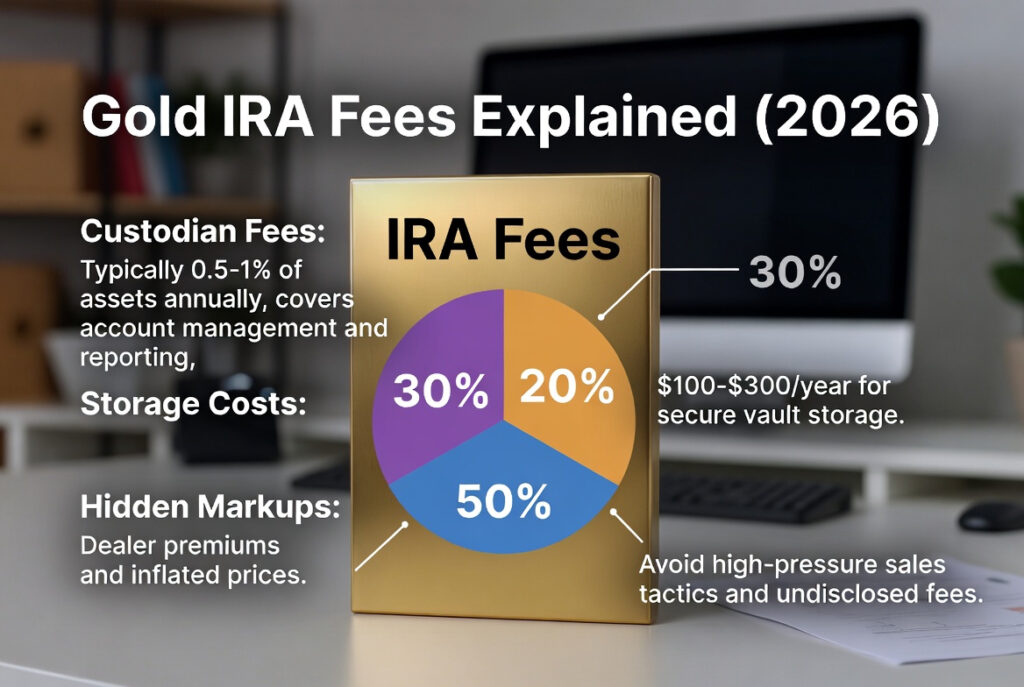
This guide breaks down Gold IRA fees in plain English, shows you what “normal” looks like in 2026, and gives you a practical framework to calculate your all-in cost before you fund anything.
Compliance note: This is informational content, not financial, legal, or tax advice. Speak with a qualified professional for guidance specific to your situation.
Key Takeaways
- A Gold IRA typically has three cost buckets: (1) custodian/admin fees, (2) storage/insurance fees, and (3) the dealer’s spread/premium (markup) on metals—often the largest cost that retirees underestimate.
- Regulators have warned that some precious-metals pitches rely on fear, urgency, and unclear pricing, and that transaction costs and ongoing fees can make profits difficult.
- The SEC has alleged cases involving extreme markups on coins—up to 130%—which is why itemized written quotes are non-negotiable.
- “Free silver,” “no fees,” and “storage covered” promotions can be real—but they are often funded by higher metal spreads (your real all-in cost).
Why Gold IRA fees feel confusing ?
Two structural facts create most of the confusion:
A) The “gold IRA company” in ads is usually the dealer—not the legal custodian
The company you see marketing “Gold IRAs” is typically the metal dealer (seller). A custodian legally administers your IRA, and your metal is stored at an approved depository. That’s why fees show up in multiple places—and why some dealers claim “we don’t charge fees,” while you still pay plenty.
Money makes this point clearly: annual fees are usually charged by the custodian, and storage/insurance is often owed to the depository—not the dealer.
See the list of our Top Rated Gold IRA Companies
B) Dealers rarely publish live “all-in” pricing online
You may see annual admin/storage fees listed in third-party reviews, but the largest variable is frequently the dealer spread/premium on the specific items you buy. This is also why two investors can both “use the same company” and end up with radically different outcomes.
Who charges what: the 3-entity model (and why it matters)
A compliant Gold IRA almost always involves:
- Dealer (the “gold IRA company”)
- Sells you IRA-eligible coins/bars
- Sets the premium/spread you pay over spot
- Often promotes bonuses (“free silver,” “fees waived”)
- Custodian (self-directed IRA administrator)
- Opens and maintains the IRA
- Handles reporting, recordkeeping, transactions
- Charges setup fees, annual fees, transaction fees, etc.
- Depository (storage + insurance)
- Holds the metal under custody/chain-of-control rules
- Charges storage fees (sometimes flat, sometimes percentage-based)
- Storage type matters (segregated vs commingled)
This separation exists because physical metal requires a controlled custody chain. Major finance publishers also emphasize that precious metal IRAs carry additional fees and require approved storage; you generally cannot store IRA metals at home without creating compliance risk.
The complete Gold IRA fee stack (2026 overview)
Below is a practical “map” of the fees you may face. Some investors pay only a subset depending on custodian/depository, account setup, and transaction frequency.
Gold IRA fee table (what you pay, who charges it, why it exists)
| Fee Type | Charged By | When You Pay | What It Covers | Typical Range (Market) | How to Reduce It |
|---|---|---|---|---|---|
| Account setup / application | Custodian | One-time | Opening the IRA | ~$50–$300 | Choose custodians with clear schedule; ask about promos |
| Annual admin / maintenance | Custodian | Annual | Account reporting, recordkeeping | ~$75–$300+ | Prefer flat-fee when balance grows; minimize “add-on” services |
| Transaction fees (buy/sell/wires) | Custodian (sometimes depository) | As needed | Processing purchases/sales, wires, special handling | ~$10–$95+ per action (varies widely) | Reduce frequency of trades; consolidate purchases |
| Storage & insurance | Depository (sometimes bundled) | Annual | Vaulting + insurance coverage | ~$100–$300+ or ~0.5%–1% of value | Compare segregated vs non-seg; request storage agreement pricing |
| Shipping (to depository) | Dealer / logistics | Purchase-time | Insured shipment | Often included; can be separate | Ask for insured shipping terms in writing |
| Dealer premium/spread (the “hidden fee”) | Dealer | Built into price | Dealer margin over spot | Can be modest—or extreme | Demand itemized quote + premium over spot; compare 2+ dealers |
| Account closing/termination | Custodian | Exit | Closing IRA or transferring out | Often $100–$300 | Know exit fee up front; avoid frequent transfers |
Reality check: Third-party sources commonly describe total Gold IRA annual costs in the “few hundred dollars” range, but the swing factor is the dealer premium and the transaction cadence.
Custodian fees explained (what’s normal vs questionable)
Custodian fees are the costs of administering a self-directed IRA—paperwork, compliance reporting, statements, recordkeeping, and transaction processing.
4.1 Setup / application fees
A setup fee is typically charged once when you open the SDIRA. Many schedules fall roughly within a low hundreds range, though it varies by custodian and account structure.
How to evaluate it:
- Fine to pay a reasonable one-time setup fee
- Not fine if it’s bundled with vague “processing packages” you can’t verify
4.2 Annual maintenance / admin fees
This is the recurring “keep the IRA active” cost. In the Gold IRA world, annual maintenance commonly ranges from under $100 to a few hundred dollars depending on custodian and account type.
Two common fee models:
- Flat annual fee: predictable; often better as your balance grows
- Scaled by assets: can look cheap at small balances but becomes expensive over time
Buyer rule: You want the custodian to provide a fee schedule PDF or signed schedule (not just a verbal estimate).
4.3 Transaction and processing fees (the sneaky budget killer)
Transaction fees are where “reasonable” accounts can become expensive. Examples include:
- Wire fees
- Purchase/sale processing
- Special handling forms
- Expedited processing
- Distribution processing (liquidation or in-kind)
If you intend to buy once and hold, transaction fees matter less. If you plan to “average in” with multiple purchases a year, they matter a lot.
What to ask (verbatim):
- “What fees apply for each purchase inside the IRA?”
- “What fees apply if I sell inside the IRA?”
- “What are the wire, check, and processing fees?”
- “What are termination/transfer-out fees if I move custodians?”
4.4 Termination / transfer-out fees
Exit fees are common and not automatically “bad.” They are bad when they’re not disclosed or are bundled with surprise service fees at the end.
Storage & insurance fees: what you’re really paying for
A core reason Gold IRAs cost more than brokerage IRAs is that physical metal must be held in secure custody.
5.1 Segregated vs non-segregated storage (and the price difference)
Non-segregated (commingled) storage
- Your metal is held with like-kind metals belonging to other IRA clients
- Lower cost
- You own an equivalent interest in the deposited metal under the custodian’s records
Segregated (allocated) storage
- Your specific items are stored separately
- Higher cost
- Often preferred by investors who want additional tracking assurance
Money notes that some providers describe annual fees as a combination of an account fee and a segregated storage/insurance fee.
5.2 Flat-rate vs percentage-based storage fees
Storage can be priced in two main ways:
- Flat annual fee (e.g., $100–$300+)
- Percentage of metal value (often described as ~0.5%–1% per year in general references)
You should ask which applies—because a percentage-based model becomes meaningfully more expensive as your account grows.
5.3 Example: Delaware Depository fee schedule reality
Depository pricing can include additional service fees beyond basic storage (e.g., audit assistance, special handling). Delaware Depository publishes a fee schedule that includes items like hourly account/audit assistance.
You do not need to memorize depository line items—but you do need to know whether:
- storage is segregated or commingled,
- pricing is flat or percentage-based,
- insurance is included,
- and whether there are extra fees for audits, verification, or special movements.
The “hidden” cost that matters most: dealer spreads, premiums, and markups
If you take only one concept from this guide, take this:
Your biggest cost is often not custodian fees. It’s what you pay above spot for the metals.
Key definitions
- Spot price: the reference market price for the raw metal
- Premium: amount above spot reflecting fabrication, distribution, dealer margin
- Spread: difference between dealer sell price and dealer buyback price
- Markup: the dealer’s margin embedded in the product price (can be reasonable or abusive)
6.1 Why “free silver” is rarely free
Major consumer finance coverage has warned that “free metals” claims can be funded by a larger spread baked into your purchase price.
This doesn’t mean all promotions are scams. It means you should treat promotions as accounting, not generosity.
Investor math:
If you receive $5,000 “free” silver but overpay by $7,500 in inflated premiums, you did not win.
6.2 The regulator warning you should not ignore
Regulators have publicly emphasized that transaction costs and ongoing fees can make it difficult for victims to ever profit—and have encouraged retirees to ask direct questions before rolling money into metals.
FINRA and the CFTC have jointly published “questions to ask” before buying physical metals, specifically noting that precious metals IRA frauds often target retirees.
6.3 Extreme markups happen (and the SEC has alleged them)
The SEC has alleged that a precious metals firm charged markups as high as 130% on coins sold to investors.
Again, this does not mean every dealer does this. It proves the risk is real—and why you need a written, itemized quote with product-level pricing.
6.4 The “collectible coin” trap (how retirees get overcharged)
Some dealers push high-premium “collectible-style” coins as the default IRA purchase because:
- high premiums increase dealer margin
- these products can be harder for consumers to benchmark
- the sales pitch often leans on scarcity or “special protection” narratives
Your defense is simple: insist on comparing IRA-eligible bullion equivalents and ask the rep to justify the choice in writing.
What a Gold IRA really costs: realistic examples
Let’s model outcomes so you can see why small differences in spread/premium matter more than the $200–$300 annual fees.
Scenario A: The disciplined buyer (reasonable pricing)
- IRA rollover: $100,000
- Custodian + storage baseline: ~$250/year (varies)
- Dealer premium on bullion: ~4%
- All-in metal purchase: $96,000 “metal value” for $100,000 invested (illustrative)
Cost impact:
- $4,000 paid as premium/spread
- plus baseline fees over time
Scenario B: The “bonus-driven” buyer (inflated pricing)
- IRA rollover: $100,000
- Same baseline admin/storage: ~$250/year
- Dealer premium: 15% (often hidden behind “free silver” + urgency)
- All-in metal purchase: $85,000 “metal value” for $100,000 invested (illustrative)
Cost impact:
- $15,000 paid as premium/spread—immediately
- far more damaging than the baseline annual fees
Scenario C: The worst-case outcome (regulator-style markup risk)
The SEC has alleged markups as high as 130% in a case involving coin sales.
You never want to be in a position where your portfolio must climb dramatically just to break even on the original purchase price.
How to compare Gold IRA quotes correctly (copy/paste checklist)
When you request a quote from any Gold IRA dealer, ask for an itemized quote with the following fields:
Quote checklist:
- List the exact products (coin/bar name, weight, mint/refiner).
- Quantity of each item
- Total price per item
- Spot price used and timestamp of quote
- Premium over spot per item (dollars and percent)
- Estimated buyback policy and how pricing is determined
- Custodian fee schedule (PDF or written schedule)
- Depository/storage option (segregated vs commingled) and cost
- Any transaction/wire fees (purchase and liquidation)
- Total first-year cost estimate (admin + storage + any setup fees)- Learn how to compare Gold IRA Quotes.
The “same basket” comparison rule
To compare Dealer A vs Dealer B, you must quote the same basket:
- same products
- same quantities
- same storage type
- same custodian model if possible
Otherwise, dealers can “win” by quoting different products with different premiums.
Fee red flags (how to spot bad deals fast)
Here are the patterns that consistently lead to expensive mistakes:
Red Flag 1: Refusing to disclose premiums over spot
If you ask “What premium am I paying over spot?” and the rep won’t answer, you should assume the premium is uncompetitive.
Red Flag 2: “Today only” deadlines and fear scripts
Regulators have repeatedly warned retirees about precious-metals fraud and high-pressure tactics that exploit fear and urgency.
Red Flag 3: “No fees” claims that ignore the real cost stack
Even if the dealer charges no visible admin fee, you still pay custodian and storage fees—and you still pay a spread on metals.
Red Flag 4: “Home storage inside the IRA” pitches
Mainstream guidance emphasizes that storing IRA metals at home is a compliance risk and that approved storage is required to maintain tax-advantaged status.
Red Flag 5: Bonuses that don’t come with transparent math
If the promotion is clear but the premium is not, you are likely paying for the bonus yourself through pricing.
2026 context that matters (quick note)
While this article focuses on fees, it’s worth noting that the IRS announced the 2026 IRA contribution limit increased to $7,500, with a catch-up amount of $1,100 for age 50+ (subject to eligibility rules).
Practical reality: many Gold IRAs are funded via rollovers/transfers (not annual contributions), but contribution limits still matter for new money planning.
FAQs: Gold IRA Fees (People Also Ask)
How much does a Gold IRA cost per year in 2026?
Most investors should expect custodian + storage baseline costs in the low hundreds per year, but the real determinant of total cost is often the dealer premium/spread on the metals you buy. Major consumer sources similarly note that Gold IRAs carry higher fees than traditional IRAs because of custody and storage requirements.
What are the “hidden fees” in a Gold IRA?
The most common “hidden” cost is not a line-item fee—it’s the premium/markup over spot embedded in the product pricing. Promotions like “free metals” may be offset by higher spreads.
Is segregated storage worth paying extra for?
It depends on your priorities. Segregated storage can provide additional item-level separation, but it typically costs more than commingled storage. The right choice is the one you understand and can verify in writing (storage type + cost + insurance terms).
Can a dealer legally charge huge markups on coins?
Pricing can vary, but regulators have brought enforcement actions alleging extremely high markups and misleading sales practices—underscoring why you must demand written, itemized quotes and compare.
What questions should I ask before I roll over into a Gold IRA?
Start with the FINRA/CFTC investor bulletin questions and then add your own quote discipline. Regulators explicitly encourage asking detailed questions about costs, risks, and claims.
Bottom Line: The fee framework that protects you
A Gold IRA can only work as intended when you control the two things that matter most:
- Predictable account-level fees (custodian + storage)
- Competitive metal pricing (reasonable premiums/spreads)
If you want a buyer-safe approach, use this rule:
Do not fund a Gold IRA until you have (a) a custodian fee schedule, (b) a storage cost confirmation, and (c) an itemized product quote that states the premium over spot—then compare at least one competing quote using the same IRA-eligible items.
Written by Mike Reeves
Mike Reeves is a Gold IRA and precious metals IRA specialist with over 10 years of industry experience, having evaluated dozens of providers across the United States. He has helped hundreds of investors roll over traditional retirement accounts into precious metals IRAs, with a focus on fee transparency, compliant storage, and investor-first guidance.
Last updated: January 2026