


Disclosure: IRA Wealth Guide may earn compensation from some links or partner placements. That never changes our evaluation criteria or recommendations.
Not financial advice: This page is educational. Consult a qualified tax professional or financial advisor for advice specific to your situation.
Written by Mike Reeves
Mike Reeves is a Precious Metals IRA specialist with over 10 years of industry experience, having evaluated dozens of providers across the United States. He has helped hundreds of investors roll over traditional retirement accounts into precious metals IRAs, with a focus on fee transparency, compliant storage, and investor-first guidance.
Last updated: January 2026
Start Here: The simple answer
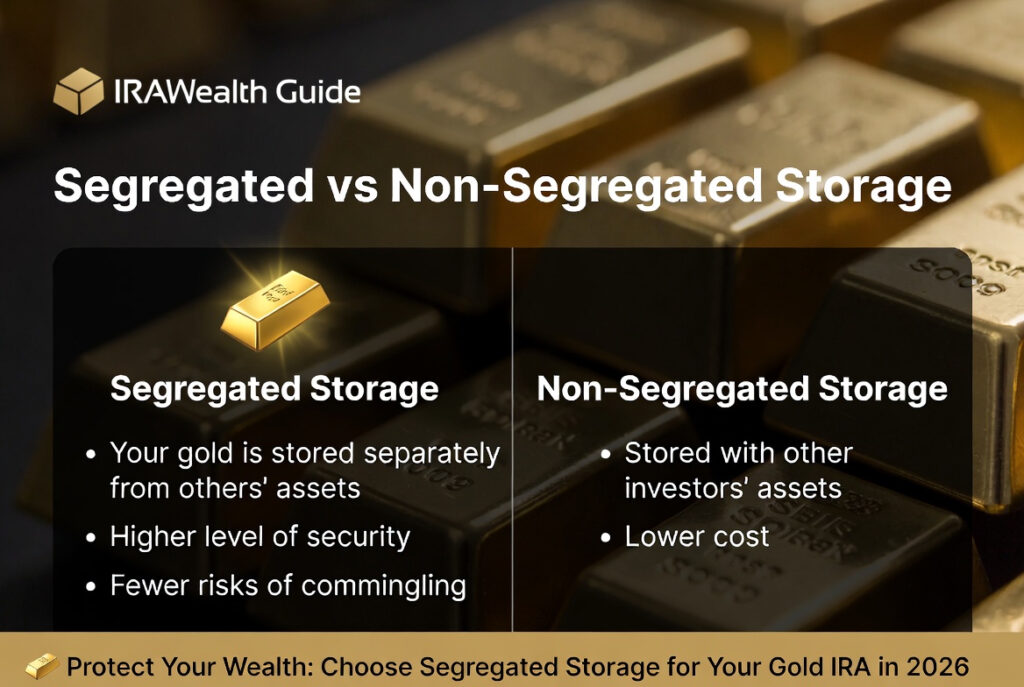
Segregated storage means your IRA metals are stored physically separate and clearly labeled as yours, and you receive back the same exact coins/bars deposited. Non-segregated storage (often called commingled) means your IRA metals are stored with other clients’ metals of the same type, and you receive the same type/quantity back—but not necessarily the same serial-numbered bars or specific coins. Delaware Depository describes segregated storage as more labor/space intensive and therefore more expensive than non-segregated storage.
Both storage types can be IRA-compliant when handled through a qualified custodian/depository structure, because the IRS bullion exception hinges on a bank or approved non-bank trustee maintaining physical possession of the bullion.
Why storage matters (more than most investors think)
Most buyers treat storage like a checkbox: “Somewhere secure.” In reality, storage decisions affect:
- Compliance posture (chain of custody and physical possession requirements)
- Annual cost structure (segregated usually costs more)
- How liquidation/distributions are handled (particularly for in-kind deliveries)
- Audit trail and reporting comfort (how clearly your holdings are documented)
- Peace of mind (some investors simply prefer “my metal is isolated”)
The key point: You’re not just choosing a vault—you’re choosing the custody model for an asset inside a retirement account with specific rules.
The compliance baseline: what the IRS actually cares about
“Home storage Gold IRA” sales narratives are common because they sound empowering. But the IRS bullion exception ties eligibility to physical possession held by a bank or approved non-bank trustee.
Practical translation
In a standard, compliance-first Gold IRA setup:
- Your IRA is administered by a custodian
- Your metals are held at an approved depository under custody/chain-of-control
- You do not personally store IRA metals at home while calling them “inside the IRA”
This is not about fear—it’s about following the structure the IRS contemplates for IRA-held bullion.
Definitions (so you don’t get misled on calls)
Segregated storage
Meaning: Your metals are stored separately from others, packaged/labeled as your holdings, and you receive the same exact bars/coins originally deposited.
Delaware Depository describes segregated storage as bullion being inspected, packaged, labeled, and stored physically separate from other customers’ bullion, and notes the cost is higher due to labor and space requirements.
Typical best for: investors who prioritize item-level traceability and maximum peace of mind.
Non-segregated storage (commingled)
Meaning: Your metals are stored in a shared area with other clients’ metals of the same type. Your ownership is tracked on the custodian/depository’s books, and you receive the equivalent metals (same type and quantity)—but not necessarily the identical serial-numbered bar(s) or exact coins.
Typical best for: investors who want lower annual costs and are comfortable with equivalency accounting, assuming the depository’s controls and audits are robust.
Allocated vs unallocated (important nuance)
Storage discussions often get muddy because “segregated vs commingled” is not the same thing as “allocated vs unallocated.”
- Allocated means the depository/custodian records that specific metals are held for customers (ownership is specifically recorded).
- Unallocated is more like a general claim on metal inventory rather than clearly assigned specific holdings; it’s common in certain institutional bullion markets but is not how most investors think of a physical metals IRA.
For most consumer Gold IRAs, your decision is usually between segregated allocated and commingled allocated storage models.
Segregated vs non-segregated: side-by-side comparison
Use this table to make a clean decision quickly.
| Factor | Segregated Storage | Non-Segregated (Commingled) Storage |
|---|---|---|
| What happens to your metals | Stored physically separate and labeled | Stored with others’ metals of the same type |
| Do you receive the exact same items back? | Typically yes | Usually equivalent items, not necessarily the same serial-numbered bars |
| Annual storage cost | Typically higher | Typically lower |
| Best for | Maximum item-level traceability and peace of mind | Cost optimization and simplicity |
| Operational complexity | Higher (more handling, labeling) | Lower |
| Investor psychology fit | “I want my exact metal” | “I want the lowest friction and cost” |
| Compliance (if done through custodian/depository) | Can be compliant | Can be compliant |
The decision framework (use this before you choose)
Most investors choose based on a single sentence:
- If you want the strongest “that is my metal” feeling: segregated
- If you want cost efficiency and are comfortable with equivalency accounting: non-segregated
But the best decision uses a few more inputs.
Choose segregated storage if…
1) Peace of mind is your #1 priority
If you will lose sleep wondering “Is my metal mixed with others?” you’ll get more value from segregated storage than you’ll pay in additional annual fees.
2) You plan to take in-kind distributions later
If you anticipate taking physical delivery as a distribution in retirement (rather than liquidating for cash), segregated storage can feel conceptually cleaner.
3) You own products that are meaningfully non-standard
For example:
- Mixed sets of coins from multiple mints/years
- Many smaller bars with serial tracking
- Items you want specifically returned as deposited
4) You want the most intuitive audit trail for personal confidence
Even if both are “auditable,” segregated storage is easier to understand: your items are isolated.
Choose non-segregated storage if…
1) You care about minimizing fixed annual overhead
Storage/admin fees are “certain costs.” Your metal’s price movement is not. Many cost-sensitive investors choose non-segregated to reduce fee drag.
2) You are buying standard bullion products with deep liquidity
If your IRA holdings are mostly common, highly liquid products, commingled storage often works well.
3) You’re building a smaller starting position
If you’re starting with a lower balance, paying extra annually for segregated may feel disproportionate.
4) You want operational simplicity
Non-segregated storage is typically lower handling intensity and can be faster in certain workflows.
What storage does (and does not) change about security
A common misconception is that segregated storage is “more secure.” In reputable depositories, both models should be stored in high-security vault environments. The difference is segregation and identification, not necessarily “guards vs no guards.”
What actually drives real security
Regardless of storage type, focus on:
- depository reputation and controls
- insurance coverage structure (ask for a summary)
- audit practices and reporting
- chain of custody processes
- how the custodian documents your holdings
If a dealer tries to claim commingled storage is unsafe by default, treat that as marketing, not analysis.
Real-world cost implications (what you should expect)
Delaware Depository explicitly notes segregated storage costs more because it requires significant labor and space.
Beyond that, exact pricing is not universal because:
- custodians may have negotiated schedules with depositories
- fees can vary by asset value, metal type, and storage type
- “flat” vs “tiered” pricing models differ between custodians
Investor-first cost rule
Never choose a storage type without getting the annual storage + insurance fee in writing for your exact custodian + depository combination.
Internal link: For the full fee stack and quote checklist, link to: /gold-ira/fees/
The storage process (what actually happens behind the scenes)
Understanding this helps you ask better questions and avoid vague answers.
Step 1: Your custodian opens the account and approves the purchase
Your custodian is the IRA administrator. Your dealer is not the custodian.
Step 2: The dealer ships metals to the depository under insured chain of custody
The shipment should be insured and documented, then received by the depository.
Step 3: Receiving + verification + recording
The depository receives and verifies, then records holdings under your IRA’s account.
Step 4: Storage model is applied (segregated or non-segregated)
- Segregated: inspected, packaged, labeled, and stored separate
- Non-segregated: pooled storage with ownership recorded
Step 5: Reporting
Your custodian provides periodic reporting. Many depositories support inventory and reporting services.
“Location” and “depository choice” (what matters and what doesn’t)
Some investors choose a depository based on geography (Delaware vs Texas vs Utah, etc.). That can be fine, but make sure your reasons are rational:
Good reasons to care about location
- You want a specific depository you trust
- Your custodian offers pricing advantages at certain locations
- You want optionality for distributions and logistics later
Weak reasons to overemphasize location
- “Closer to me means I can get it faster” (not necessarily true)
- “One state is immune from all political risk” (generally overstated)
Depository capabilities: what you should ask
- Do you offer both segregated and non-segregated storage? (Delaware Depository does.)
- What is the cost difference through my custodian?
- How is insurance structured and documented?
- What is the audit process and how often is inventory reconciled?
- How are in-kind distributions handled?
The questions you should ask (use these verbatim)
These questions are designed to force clarity and prevent expensive misunderstandings.
Questions for the dealer
- “Which depository will hold my metals, and do I have a choice?”
- “What storage types are available for that facility: segregated and/or non-segregated?”
- “Give me the annual storage and insurance cost in writing for each option.”
- “If I choose non-segregated storage, do I receive the same exact serial-numbered bars back, or an equivalent?”
- “If I take an in-kind distribution later, what exactly happens?”
Questions for the custodian (more important than most investors realize)
- “Can you confirm the storage type I select is properly documented under my IRA?”
- “How will my holdings appear on statements?”
- “Are there transaction fees for shipping, liquidation, or distributions?”
- “What fees apply if I change depositories later?”
Red flags: storage-specific sales tactics that should make you pause
Red flag 1: They refuse to put storage fees in writing
If a firm can quote a premium metal product, it can quote a storage fee.
Red flag 2: They use storage fear to rush you
“Commingled is dangerous—sign today.” That’s pressure, not analysis.
Red flag 3: “Home storage” framed as a simple workaround
The IRS bullion exception is explicitly tied to physical possession by a bank or approved non-bank trustee.
If someone pitches home storage as obviously safe and universally accepted, validate with independent tax counsel.
Red flag 4: They confuse you with terms on purpose
“Allocated, segregated, private, vault, special storage…”
Ask: “Is it segregated or non-segregated, and will I receive the same exact items back?”
Which storage type is best for most people?
Most first-time Gold IRA buyers are best served by one of these approaches:
Option A: Default to non-segregated for cost efficiency (common)
Best for:
- smaller starting balances
- investors prioritizing lower fixed annual costs
- standard bullion holdings
Option B: Choose segregated if you’re investing larger amounts or want maximum peace of mind
Best for:
- investors with larger allocations
- investors who will worry unless holdings are isolated
- those planning in-kind distributions
Buyer-first truth: There’s no universal “best.” The right answer is the one you’ll stick with confidently while maintaining cost discipline.
A practical “storage selection” checklist (copy/paste)
- My custodian confirmed the depository and storage type options
- I received annual storage + insurance fees in writing for both options
- I understand whether I receive the exact same items back (especially for bars)
- I know the transaction fees for future shipments, liquidation, and distributions
- I understand segregated vs non-segregated and allocated vs unallocated
- I’m not choosing based on pressure or fear tactics
- I compared at least one provider’s storage fees for sanity checking
How storage choice affects your “all-in” Gold IRA cost
Storage is only one layer. Your total outcome is driven by:
- custodian fees (setup + annual + transaction)
- storage fees (segregated vs non-segregated)
- dealer spread/premium (often the largest variable)
Recommended next steps (conversion-forward, low pressure)
If you’re researching storage because you’re close to opening an account:
- Read Gold IRA Fees Explained (2026)
- Confirm IRS-Approved Metals
- Compare providers in Best Gold IRA Companies
- Use your Compare Quotes checklist
Segregated vs Non-Segregated Storage FAQs
Is segregated storage worth it for a Gold IRA?
It can be, especially if you value item-level identification and want the same exact bars/coins returned. Delaware Depository notes segregated storage requires more labor/space and therefore costs more—so “worth it” depends on how you weigh peace of mind vs annual fee drag.
Is non-segregated storage still safe?
In reputable depositories, both models are designed for secure custody. The difference is how metals are identified and stored (separate vs pooled), not whether a facility uses vaulting controls.
Will I get my exact gold back with non-segregated storage?
Typically you receive the same type and quantity, but not necessarily the same specific items. If receiving the same serial-numbered bars is important to you, choose segregated storage and confirm in writing.
Does the IRS require segregated storage?
No. The IRS requirement for bullion eligibility is tied to physical possession by a qualified trustee/custodian—not to segregated vs non-segregated.
Why do some companies push segregated storage so aggressively?
Because it can be framed as “premium security,” and in some cases it may increase annual storage fees. Treat aggressive pushing as a cue to slow down and request written pricing and clear explanations.
Bottom Line: The storage choice that wins
If you want the clearest ownership trail and maximum peace of mind, choose segregated storage—and accept the higher annual cost.
If you want lower fixed costs and you’re comfortable receiving equivalent metals of the same type, choose non-segregated (commingled) storage.
Either way, your “best” outcome depends on getting two things in writing before you fund:
- your annual storage + insurance fee for each option, and
- confirmation of how your metals are identified and returned.